
Campaigns that drive trust also more likely to deliver business impact, research finds

Building trust has also become a more popular goal for campaigns, according to analysis of data from IPA Effectiveness Databank.
 There is a strong correlation between driving trust through advertising and delivering business effects with those campaigns, suggests data from the IPA.
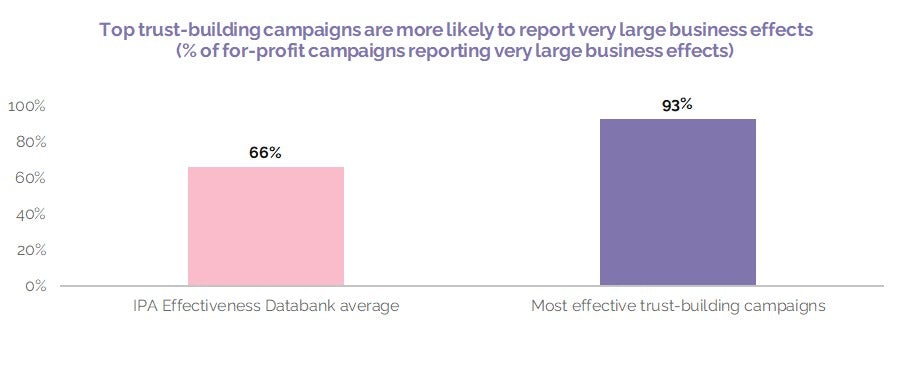
The analysis, which looked at campaigns in the IPA Effectiveness Databank, finds 93% of for-profit advertising campaigns that report very large increases in brand trust also record at least one very large business effect, such as sizable growth in sales, market share or profit. This compares to 66% of all for-profit campaigns in the Effectiveness Databank.
This means campaigns effective in delivering increased trust are typically 27 percentage points (41%) more effective in driving business growth.
Splitting out the specific business effects that trust-driving campaigns deliver, these campaigns are significantly more likely to deliver sales volume gains. Almost two in five (37%) for-profit campaigns that drive trust also deliver sales volume gains, compared to 26% across the IPA Effectiveness Databank.
Similarly, 35% of trust-driving campaigns also delivered profit growth, versus 24% of all campaigns in the databank. Over tenth (11%) of trust-driving campaigns also delivered a reduction in price sensitivity compared to 6% of campaigns generally.
As well as delivering business effects, the most effective trust-building campaigns also deliver much stronger brand effects. These campaigns are more than twice as likely as the for-profit Databank average to report very large improvements in perceptions of brand quality (59% for most effective trust-building campaigns versus 20% for the IPA Effectiveness Databank Average) and brand loyalty (56% versus 23%).
Trust becoming a priority
Creating advertising that drives trust can act to deliver business and brand effects, suggests the analysis of the IPA Effectiveness Databank. Perhaps because of the success seen by trust-driving campaigns, they have become more popular among marketers.
Between 1998 and 2009, fewer than four in 10 of all campaigns in the Databank included building brand trust as an objective. By 2020 to 2024, that figure had risen to more than two thirds.
In addition, between 1998 and 2024, 80% of campaigns reporting a very large trust effect had set increasing brand trust as a primary or secondary objective of their campaigns.
The effectiveness of trust-building campaigns has also increased. Since 2012, the most effective for-profit trust-building campaigns have seen a 56% increase in the average number of very large business effects, alongside a 19% increase in very large brand effects.
The research also suggests that trust-building campaigns tend to use more channels. The most effective trust-building for-profit campaigns on average employ 10.7 channels versus an average of 9.9 channels across all campaigns.
link

/https://i.s3.glbimg.com/v1/AUTH_63b422c2caee4269b8b34177e8876b93/internal_photos/bs/2026/S/B/7tcnNwRWuM0qjxiJPdDQ/foto09emp-101-chat-b6.jpg "When advertising enters the conversation with consumers")


