
Building Brand Communities and Lasting Consumer Connections
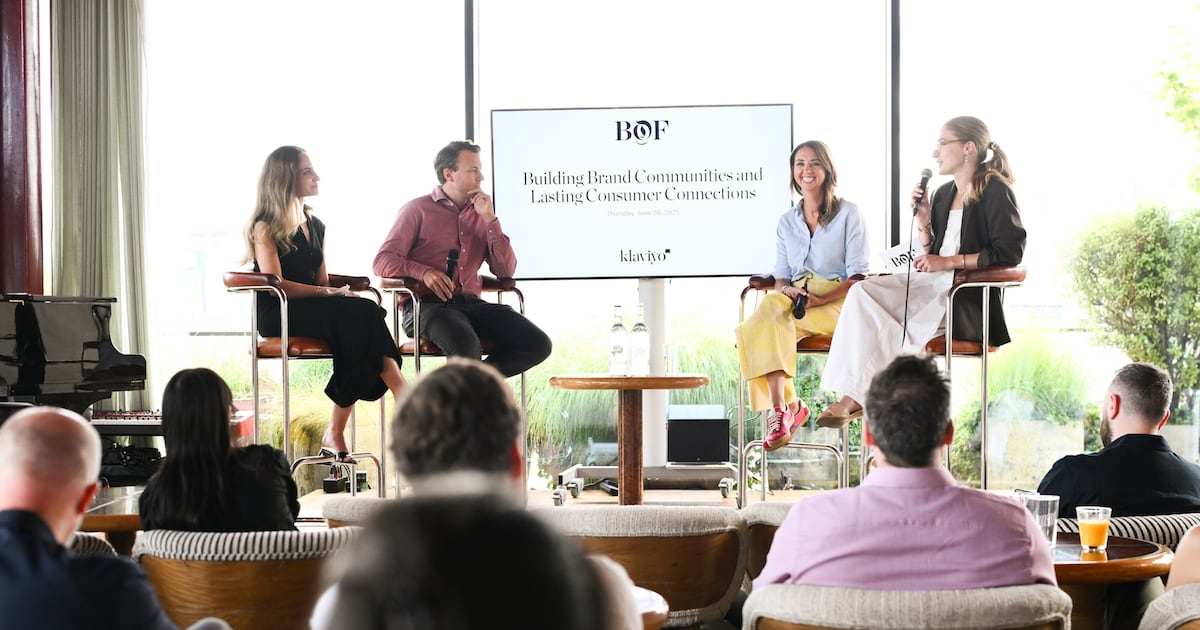
Today, consumer markets like fashion and beauty are heavily oversaturated — with both shoppers and brands negatively impacted by this reality.
Eighty percent of Gen-Z consumers report feeling overwhelmed by their exposure to brands, according to The Business of Fashion’s (BoF) The State of Fashion 2025 Report, published in partnership with McKinsey & Company. Seventy-four percent of customers report walking away from online purchases due to the volume of choice.
“You have to have a great product, you have to build a great brand, but you really have to build a relationship with your customer so that they have brand loyalty. It’s how you talk to them, where you talk to them, and how you connect with them over time,” said Jamie Domenici, chief marketing officer at Klaviyo, during a panel discussion hosted by BoF and Klaviyo in London.
As a CRM platform built for B2C brands, Klaviyo consolidates marketing, service and analytics into a single platform. Powered by Klaviyo’s data and built-in AI, the platform facilitates personalised customer relationships. With over 167,000 customers, including Skims, Dermalogica and Paul Smith, Klaviyo seeks to improve efficiencies, deliver personalised experiences at scale, and accelerate revenue for global consumer brands.
Domenici was joined onstage by Shaghig Babikian, head of organic and lifecycle marketing at fashion retailer Asos, and Richard Ward, CEO of e-commerce service provider THG Ingenuity, which works with business like L’Oréal, P&G, Disney and Lookfantastic.
Moderated by BoF’s commercial features director Sophie Soar, the panellists shared their strategic insights for building community, fostering loyalty and measuring impact in today’s market.

Shifting Focus from ‘Retention’ to ‘Relationship-Building’
Brands must pull strategic levers that offer consumers a point of difference — from utilising behavioural data patterns to create targeted marketing moments or messages.
With a 60 percent increase in e-commerce customer acquisition costs from 2017 to 2022, according to The State of Fashion 2025 Report, the focus for many is on retaining existing consumers — to foster emotional connections, a sense of community and belonging through hyper-personalised touch points.
We’re always asking for feedback. The loyalty programme almost makes it feel like we’re closer to customers — we hear them better and they feel like we are listening to them.
— Shaghig Babikian, head of organic and lifecycle marketing at Asos.
“I don’t like the term ‘retention’ anymore. You’re not trying to retain your customers — you’re trying to build an ongoing relationship with them,” added Domenici. “You have to build a lifetime of events and milestones with customers to keep them coming back.”
Ward noted the importance of building consumer connections within different markets through strategically leveraging brand values — aligning their unique messaging with different communities to foster relationships.
BoF’s case study ‘How Brands Build Genuine Communities’ shares that brands with the strongest communities tend to tap into three main values-oriented missions: “activity-driven, typically based on a foundation of sports or other physical activities; personality-driven, coalescing around a magnetic brand founder or leader; and values-based, where customers congregate around a brand because of shared beliefs or perspectives.”
“We’re often trying to work with our customers and go, well, these are your brand values. These are the communities that exist in these different markets. How do we marry the two?” says Ward. “It is around being customer-obsessed and having that personal connection with a brand. So, all of these incremental things that you tactically are the incremental gains that you get with the connection and then therefore driving that long-term, lifetime value.”
Domenici shared that, during Black Friday last year, Klaviyo saw a notable shift in brand choice for consumer expenditure: rather than prioritising the biggest discount, consumers were attracted to brands they already had a relationship with.
“That means that you have to build a relationship with your customer over time — it’s not going to happen just in one click; it’s going to take multiple interactions,” she said. “This is where you have to depend on your technology to surface up those patterns to make them actionable. So when the time comes to drop that offer, whether it’s 20 percent off or free shipping, you already have a relationship with the customer.”
Here, Domenici shared the value of multi-touch attribution, which allows for a holistic interpretation of the customer relationship with a product. “You are able to actually look across every single channel and now truly understand if someone touches a product 10 times, so that wasn’t just an email that drove the result — it was actually all 10 of those touches,” she added.
Removing Barriers to Discovery
In order to streamline customer journeys, and increase the likelihood of conversion and loyalty, businesses should work to remove barriers to brand and product discovery. In The State of Fashion 2025 report, 41 percent of survey respondents cite irrelevant results as a main barrier to shopping.
“One of the biggest pain points that we see at Asos is coming from the sheer range of products that we have,” said Babikian. “We have this great assortment which means we can appeal to a very diverse suite of customers, but it also means that the risk of overwhelming customers is very real.”
People want to interact with your brand at different times, in different ways and in different places.
— Jamie Domenici, chief marketing officer at Klaviyo.
To combat this, Asos’ leverages product lifecycle campaigns, which include notifications that a customer’s saved item has reduced in price, or that a favourite item is back in stock, facilitating that purchasing experience and creating a more frictionless shopping experience.
Ward notes the importance of “understanding what’s going on at any given moment with the consumer’s life, where they might be at that particular time,” which can be translated into targeted ads. “You can raise credibility and you have significant convenience related to that transaction.”
He shared an example of a recent conversation with a wellness brand and the opportunities they discussed on upselling different products “that might be relevant to the lifestyle that they’re leading, based on all of these [data] indicators that come through.”
Then, send a “healthy nudge,” he said. “‘You’re about to run out, we can see you are running out, would this be helpful?’ It’s all about removing friction.”
Consolidating Data for Optimised Personalisation
Thinking holistically about customer behaviour across channels can offer a wider lens on how to enhance the customer experience, and in particular, how to leverage personalisation. Indeed, 71 percent of customers expect personalised targeting from brands, with 67 percent frustrated when this doesn’t happen, according to research by McKinsey & Co.
At Asos, the fashion retailer uses customer segmentation across behavioural, transactional and demographic data points to segment audiences across its 24 million customers. This approach helps to inform their personalisation strategy.
“What this allows us to do is to create all these different segments that we can target — and that could be [anyone] from big spenders [and] return customers [to] first time buyers,” Babikian said. “Your experience will be tailored based on what segment you’re in. Based on the tier that you’re on, your whole experience will be tailored based on that, or if we’re targeting customers with personalised incentives, a personalised level of discount, or maybe features on the app that are available to a certain set of customers.”
This segmentation data is shared across channels, making it actionable across all corners of marketing — from CRM to paid and organic marketing channels — but also to the tech team to create personalised on-site experiences.
Domenici emphasised the importance of interpreting customer data to consider channel preferences — and highlighted that much of this data collection occurs post-purchase.
Aftercare plays a critical role in fostering the connection with a customer once they have purchased — to demonstrate the value placed in the individual outside of a transaction.
“People want to interact with your brand at different times, in different ways and in different places,” said Domenici. “At Klaviyo, we capture all of that information, not just in marketing now but also support post-sale, what’s happening after they buy with your brand. We try to consolidate all of that information in one place to make it easy to take the data in, and also make it actionable.”
Combining Qualitative with Quantitative Data
When it comes to measuring the success of a marketing campaign or activation, brands should look to combine qualitative with quantitative data.
Customer feedback on how the brand is spoken about online — from the comments sections on social channels and user-generated content to customer surveys and anecdotal feedback loops — are all valuable metrics to ascertain your brand-customer relationship. This information should be used in combination with data on website traffic and search metrics.
Babikian cites the example of the newly launched Asos loyalty programme, Asos World, which offers exclusive access to products, new collections, but also to in-person events.
“We piloted the programme a few months ago to a subset of customers, and within that subset of customers, there was a control group that was taken that would have been invited but wasn’t,” she said. Asos compared the behaviour of this control group with those who were invited and joined the programme, to unpack the long-term value of both groups and how they behaved in the weeks after joining the programme.
“We’re always asking for feedback. The loyalty programme almost makes it feel like we’re closer to customers — we hear them better and they feel like we are listening to them,” she added.

Sending the Right Message at the Right Time
“Timing is everything” and remains a critical factor in relationship building — and is now increasingly data-backed for marketing activations. Knowing when a customer base is more likely to convert provides a key strategic lever, which in turn is more likely to drive retention and repeat business.
“All the data that we get from our customers show that 30 percent of transactions happen after 10pm, so you’re able to then capture the audience at the right time,” said Ward. THG Ingenuity took this data learning a step further to inform its logistics planning, with the company extending its next day delivery option now as late as 1am the next morning.
“If you can convert a customer for next day delivery after 10PM, then you’re operating in a world that other people aren’t, so you’re able to capture that customer that you want,” he added. “Then, you’ve got opportunities to build brand loyalty.”
At Asos, customer engagement data is now being used to develop AI machine-learning models, to “predict the propensity of customers to churn within [a set number of] days or to purchase within [a set timeframe].”
The retailer has also seen the benefits of pushing campaigns later in the evening, such as sale-end reminders. “Being able to target only these people who we know have a high propensity to purchase within the next few days is very powerful,” she shares.
This is a sponsored feature paid for by Klaviyo as as part of a BoF partnership.
link

/https://i.s3.glbimg.com/v1/AUTH_63b422c2caee4269b8b34177e8876b93/internal_photos/bs/2026/S/B/7tcnNwRWuM0qjxiJPdDQ/foto09emp-101-chat-b6.jpg "When advertising enters the conversation with consumers")


