



Small businesses that want to thrive must reach customers where they spend their time. Today, that’s overwhelmingly on social media platforms. With over 5 billion active social media users worldwide in 2024 (expected to grow to 6 billion by 2028, according to Statista), ignoring social media marketing means missing massive opportunities for customer acquisition and retention. Smart small business owners are discovering that strategic social media use delivers measurable ROI through increased brand awareness, customer trust and direct sales conversions.
The key isn’t just being present on social platforms — it’s knowing which platforms align with your business goals, what content drives real engagement and how to measure success effectively. This guide to social media for small business marketing provides actionable frameworks for choosing the right platforms, creating compelling content and tracking metrics that matter. Plus, see real success stories from small businesses that transformed their growth through strategic social media marketing.
>> Read Next: Your Guide to Creating a Small Business Marketing Plan
Choosing the right platforms for your business

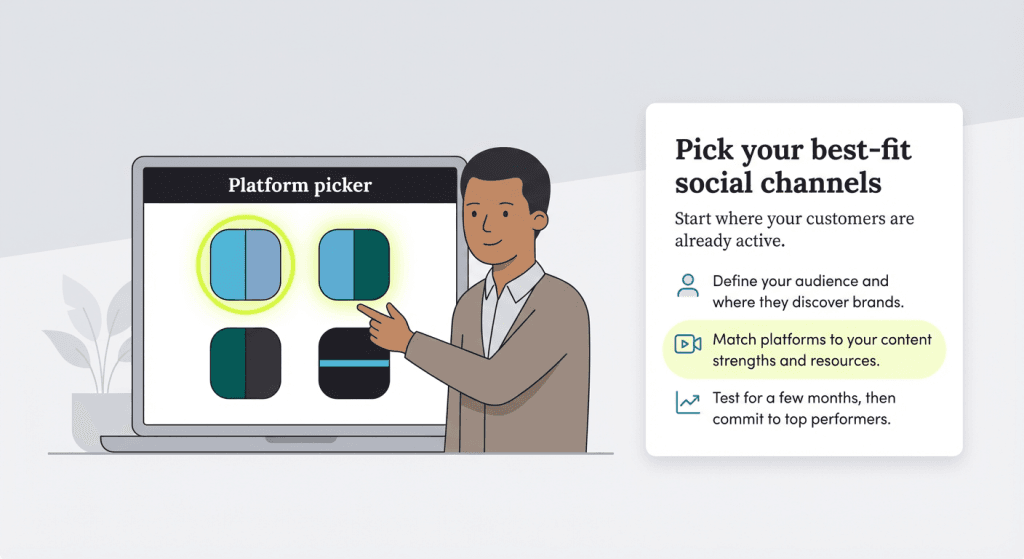
Each social network is somewhat different in its audience demographics, content types and uses. Rarely will it make sense for your small business to be on every platform.
“At this point, the big ones — Instagram, TikTok, LinkedIn, YouTube — all have billions of users,” Harding said. “It’s likely a huge proportion of your ideal customers [or] clients exist on all of them. That said, being on all of them isn’t an option for most busy business owners.”
To choose the right platforms for your business:
- Start by clearly defining your target customer demographics (age, location, interests and professional status).
- Research which platforms those specific groups use most actively for discovering new brands and products.
- Evaluate your content creation capabilities and resources.
- Test your chosen platforms for 2-3 months with consistent posting.
- Analyze which ones generate the most meaningful interactions, website traffic and actual business inquiries before committing your long-term marketing efforts.
Your business type should also influence which social media platforms are best for local business marketing.
For visual businesses (retail, restaurants, design services)
Instagram offers the perfect showcase for promoting products with captivating photos and various post formats, including photo, video, carousel and stories. If viewers see something they like, they can share the posts easily with friends via their Instagram feeds or direct messages.
“My primary platform is Instagram,” Harding said. “It’s easy to share links and move users toward your funnel, purchase page or email list. You can use a variety of content types, and [Instagram’s] constant improvements to the algorithm are making it easier and easier to get your content discovered by strangers.”
TikTok consists of videos typically viewed on mobile devices. Although it’s possible to upload videos as long as 60 minutes, most clips on TikTok are 15 seconds to one minute long. TikTok lends itself to entertainment, with many videos featuring dancing or comedy, but it can also be used for advice, education and selling products. Successful TikTok marketing tends to be lighthearted and is far from a traditional sales approach.
“TikTok obviously has some question marks surrounding it,” Gorash said, referring to a potential ban in the U.S., “but it’s still one of the best platforms for quick growth, as long as you’re creating content that resonates with the user culture.”
For B2B and professional services
LinkedIn is the world’s largest professional network. The platform allows companies to market the products and services they provide directly on their LinkedIn business profile, giving users a clear look at what your business has to offer. The “About” section on your page allows you to emphasize the voice behind your brand. Companies can even post customers’ past reviews of their business on their profiles as free advertising.
“This is a great space to showcase your business’s authority and value to potential customers or clients,” Gorash said. However, LinkedIn’s user base suggests it is most fitting for B2B businesses, not B2C ones. “[It’s] a particularly impactful platform for small businesses that benefit from B2B connections or rely on continuous learning and advancements, like in STEM industries,” he said.
Reddit dates back to 2005, but it has recently seen a surge in search results traffic as Google prioritizes information and experiences from real-life people over traditional digital publishers. The platform is essentially an online forum, with Reddit boards for different topics. Users can upvote or downvote posts and comments and privately exchange messages.
“Reddit has become a trusted place for people looking for information, advice and guidance across every topic imaginable,” Gorash said. “Small business owners can use their specific expertise to post helpful responses or start intriguing conversations that drive traffic to your website or increase your brand’s authority.”
For local businesses
Facebook offers several opportunities that small businesses should look into using. Aside from creating a page for your business and taking advantage of Meta Business Suite, you should further promote your company by sharing posts on your feed and in daily stories. Businesses can also create Facebook groups that attract their target audience and form an engaged community. In addition, one of the best tools is Messenger, which you can use to interact with, provide support, and send frequent updates to customers.
“Facebook remains useful for community-building and local awareness, particularly for businesses serving specific geographic areas,” Whittaker said.
>> Read Related Article: Best Facebook Marketing Strategies
Google Business may not look like a traditional social media platform, but Kubin considers it the “most important — and most overlooked — social media site.”
“It may not be a traditional social media platform, but I consider it the No. 1 social media site for small businesses,” she said. “Google Business functions just like any other social media site, allowing you to share photos and videos, post updates and chat with customers. But what truly sets Google Business apart is its unique ability to get you in front of local customers and get you the biggest boost for Google search rankings.”
Nextdoor connects neighbors in specific geographic areas. According to Nextdoor, 1 in 3 U.S. households has a Nextdoor account, and, like other social media sites, it’s free to create or claim a page for your business.
“[It’s] a fantastic platform if your small business market is localized,” Gorash said. “It allows you to connect directly with thousands of your neighbors and quickly increase your brand awareness by regularly engaging with them.”
For customer service and communication
X is known for its tweets, which are microposts with a 280-character limit (for unverified users) that let users say what’s on their minds in a brief amount of space. Tweets can be a great way for small businesses to show a consistent voice that aligns with their values, engages with potential consumers and reaches a particular demographic. Using X also allows you to interact with customers who have mentioned your business on their personal pages, whether in the form of positive or negative reviews.
Threads is a relatively new social media platform created by Meta to compete with X for users and advertisers. It allows users to log in using their Instagram accounts, but rather than sharing the heavily visual content common on Instagram, they can post text up to 500 characters. Threads users can also include links, photos and videos up to five minutes long in their posts. Because of its integration with Instagram, it’s easy to share posts on both sites simultaneously.
To Whittaker, the most important thing to remember is that “different platforms serve distinct purposes for small businesses.”
“Instagram works exceptionally well for visually oriented clients like boutiques, restaurants or design services, while LinkedIn proves more valuable for professional services and consultancies,” he said. “The most effective strategy involves deeply engaging on one or two platforms aligned with customer demographics rather than maintaining shallow presence across many.”
Content types that drive engagement

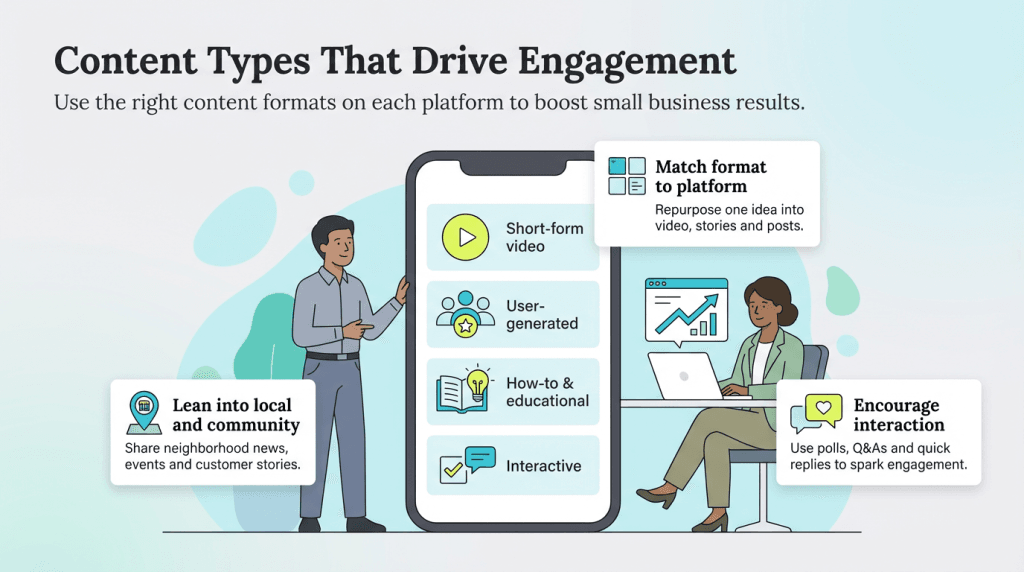
Recognizing which content types and platforms drive engagement is key to understanding how small businesses can use social media effectively.
High-performing content types
- Short-form videos: Video content consistently drives higher engagement than static posts. Platforms like Instagram Reels, Facebook Stories, TikTok and YouTube Shorts often dominate engagement across all demographics.
- User-generated content and testimonials: Encourage customers to share their experiences with your products or services on social media. Authentic content from real users builds trust and credibility with potential customers.
- Educational and how-to content: Tutorial-style content, behind-the-scenes features and educational posts have higher engagement than purely promotional content. This type of content establishes your expertise while providing value to your audience.
- Interactive content: Polls, Q&As, live videos and contests encourage active participation from your audience, boosting algorithmic visibility while gathering valuable customer insights.
- Local and community-focused content: Location-based hashtags and participation in local community conversations increase visibility among nearby social media users. This is especially valuable for service-based businesses and retail locations.
Content performance by platform
- Instagram: Mix photo, video, carousel and stories formats to maximize reach and engagement.
- TikTok: Entertainment-focused content with authentic, lighthearted approaches grabs attention.
- LinkedIn: Thought leadership content, industry insights and professional achievements generate the most engagement.
- Reddit: Helpful, expertise-driven responses and educational content add genuine value to community discussions.
- Facebook: Community-building content and local updates perform well for businesses serving specific geographic areas.
- Google Business: High-quality photos, regular updates and prompt responses to customer reviews drive visibility in local search.
- Nextdoor: Neighborhood-focused content, local promotions and community involvement posts resonate with nearby residents.
- X: Real-time updates, industry commentary and quick customer service responses perform best on the fast-moving timeline.
- Threads: Conversational, discussion-starter posts and timely responses to trending topics drive engagement.
Scheduling and posting best practices
Consistency is key to social media success, but the optimal posting frequency varies by platform.
Recommended posting frequency
- 3-5 feed posts per week
- Daily stories to maintain visibility
- Regular Reels for algorithm boosts
TikTok
- 1-4 posts daily for optimal growth
- Quality content matters more than just frequency.
- 2-4 posts per week for professional content
- Thought leadership posts and industry updates perform best.
- 2-3 authentic contributions per week in relevant subreddit discussions
- Focus on quality contributions over frequency.
- 3-5 posts per week, prioritizing quality over quantity
- Focus on community engagement and local content.
Google Business
- Weekly posts and updates
- Prompt responses to reviews and customer questions
Nextdoor
- 1-2 posts per week focused on local value
- Avoid overly promotional content.
X
- 2-3 posts daily due to fast-moving timeline
- Mix of updates, customer interactions and industry commentary
Threads
- 1-2 posts daily for conversation starters
- Active engagement with replies and trending discussions
Optimization strategies
Test different posting times, content formats and messaging to identify what resonates best with your specific audience through systematic A/B testing:
- Run controlled tests by changing one variable at a time while keeping other elements consistent.
- Post identical content at different times to identify peak engagement hours, or test the same message with different visuals to see which format drives more clicks.
- Track metrics like engagement rate, reach and click-through rate for at least two weeks before drawing conclusions.
- Document your findings to build a data-driven content strategy.
Key testing areas include:
- Post timing based on when your audience is most active
- Content formats (videos vs. images vs. carousels)
- Caption length and tone of voice
- Hashtag strategies for discoverability
- Call-to-action placement and wording
Posting best practices
- Maintain visual consistency: Use consistent colors, fonts and styling across posts to create a recognizable brand identity.
- Write compelling captions: Lead with value or intrigue in the opening line since most users only see the first few words.
- Include clear calls-to-action: Tell followers exactly what you want them to do — visit your website, share their experience, tag a friend, etc.
- Respond promptly to comments: Engage within 2-4 hours to boost algorithmic visibility and demonstrate active community management.
- Cross-promote strategically: Adapt content for multiple platforms rather than posting identical content everywhere, tailoring format and messaging to each platform’s audience expectations.
Measuring success: Essential metrics for SMBs
Proper analytics are crucial for understanding your social media return on investment.
Core metrics to track
Engagement metrics
- Likes, comments, shares and saves
- Engagement rate (interactions divided by reach or followers)
- Click-through rates to your website
Awareness metrics
- Reach (unique users who saw your content)
- Impressions (total views of your content)
- Follower growth rate
- Brand mentions and hashtag usage
Conversion metrics
- Website traffic from social media
- Lead generation through social channels
- Sales attributed to social media
- Cost per acquisition from social campaigns
Analytics tools for small businesses
Understanding social media engagement benchmarks for small businesses and your company’s social media performance requires the right measurement tools. Start with free platform-native analytics, then consider using third-party tools as your strategy grows more sophisticated.
Free platform analytics
- Instagram Insights: Track reach, impressions, profile visits and audience demographics.
- Meta Business Suite Insights: Monitor Facebook page performance, post engagement and audience behavior patterns.
- LinkedIn Analytics: Measure follower growth, post performance and professional audience insights.
- TikTok Analytics: View video performance, follower demographics and trending content data.
- Google Business Profile Insights: Track how customers find and interact with your local business listing.
Third-party analytics
- Hootsuite and Buffer: Use for cross-platform scheduling and performance comparison.
- Sprout Social: Get advanced reporting and competitor analysis.
- Later: Assists with visual content planning and performance tracking
Most social media analytics reveal the demographics of users interacting with your content, peak engagement times, and which post types generate the most clicks and conversions. Use these insights to identify your highest-value audience segments, optimize posting schedules, and double down on content formats that drive actual business results rather than just likes and comments.
Real small-business success stories
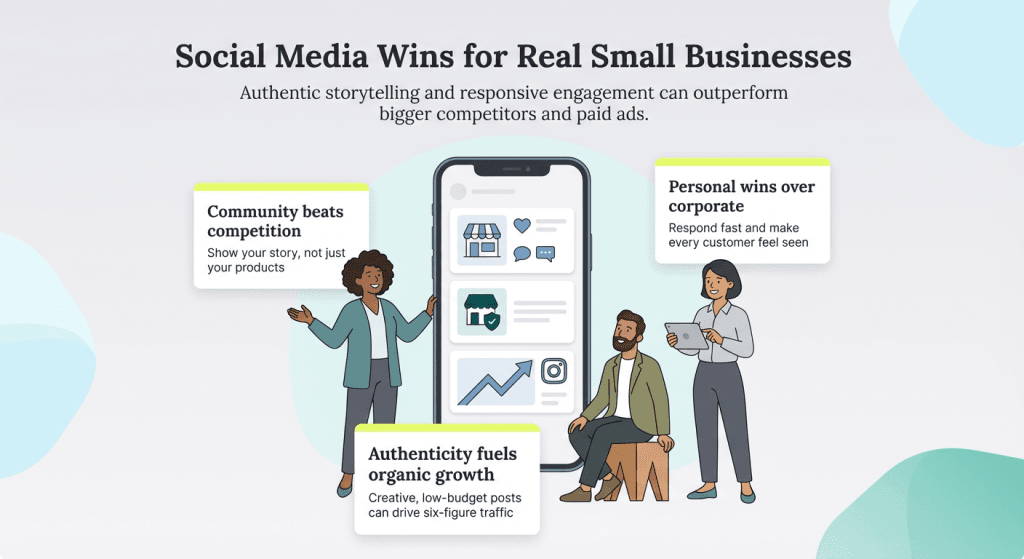
Here are three examples of small businesses using social media successfully.
Case study 1: Local retail store builds community over competition
Challenge: A small retail business, one of Whittaker’s clients, struggled to compete with larger competitors and needed to differentiate itself beyond just product offerings.
Strategy: Instead of focusing solely on product promotion, the business shifted to sharing behind-the-scenes content and featuring customer stories on social media platforms.
Results: The authentic community-building approach created personal connections with followers that translated into consistent foot traffic and customer loyalty. “Followers felt personally connected to their business journey rather than just seeing advertisements,” said Whittaker.
Case study 2: Local business outcompetes national chain
Challenge: When a national chain opened nearby, Whittaker’s local retail client faced the threat of losing customers to a larger competitor with more resources.
Strategy: The business leveraged personalized social media engagement and active social listening to quickly identify and address customer feedback — something the corporate competitor couldn’t match at scale.
Results: Despite the price competition from the national chain, the local business maintained customer loyalty through responsive, personal engagement that created emotional connections beyond transactional relationships. “Regular social listening helped them identify and address customer feedback quickly, fostering loyalty beyond what price competition alone could impact,” Whitaker shared.
Case study 3: Instagram posts generate six-figure traffic value
Challenge: Harding’s own small business needed to drive significant traffic and revenue growth without a large advertising budget.
Strategy: Harding created a targeted sales funnel and produced authentic Instagram content, including posts filmed casually “in a stained shirt and dirty hair.”
Results: The organic social media campaign generated traffic that would have cost “hundreds of thousands” through paid advertising, Harding said. “My own business revenue shot up overnight,” she reported, proving that creativity and authenticity can deliver outsized ROI for small businesses.
Streamlined step-by-step plan: From profile to profit
Follow this roadmap to launch your social media marketing strategy:
|
Step |
Action |
How to Do It |
Success Indicators |
|---|---|---|---|
|
1. Define Your Goal |
Choose your primary objective. |
Your goal may be to:
|
Clear, measurable goal established |
|
2. Pick Your Platform |
Select 1-2 strategic platforms. |
|
Platforms selected and profiles optimized |
|
3. Create Content |
Develop content strategy. |
|
Content calendar with 2-4 weeks of posts ready |
|
4. Schedule Posts |
Establish posting routine. |
|
Consistent posting schedule implemented |
|
5. Measure Performance |
Track and analyze results. |
|
Regular reporting system in place |
|
6. Adjust Strategy |
Optimize and scale. |
|
Improved metrics and growing engagement |
Quick FAQs for small business owners
Start with the platform where your target audience spends the most time. Instagram is often ideal for visual businesses like retail or restaurants. B2B companies should consider LinkedIn first. Local service businesses often find success on Facebook and Google Business. The key is choosing one platform you can manage consistently rather than spreading yourself too thin across multiple channels.
The ideal posting frequency varies by platform, but consistency matters more than volume. Aim for 3-5 posts per week on Instagram, 3-5 posts per week on Facebook, 1-4 posts daily on TikTok, and/or 2-4 posts per week on LinkedIn. Quality content posted consistently will outperform frequent low-value posts. Start with what you can maintain long-term and increase frequency as you build capacity.
- For brand awareness, monitor reach, impressions and follower growth.
- For lead generation, track website clicks, form submissions and email signups from social media.
- For sales, use platform analytics and Google Analytics to attribute revenue to social channels. Set up conversion tracking and use UTM parameters to clearly identify which social efforts drive business results.
Even simple metrics like increased foot traffic or phone calls can indicate social media success.
Jennifer Dublino and Deborah Sweeney contributed to this article. Source interviews were conducted for a previous version of this article.
link